
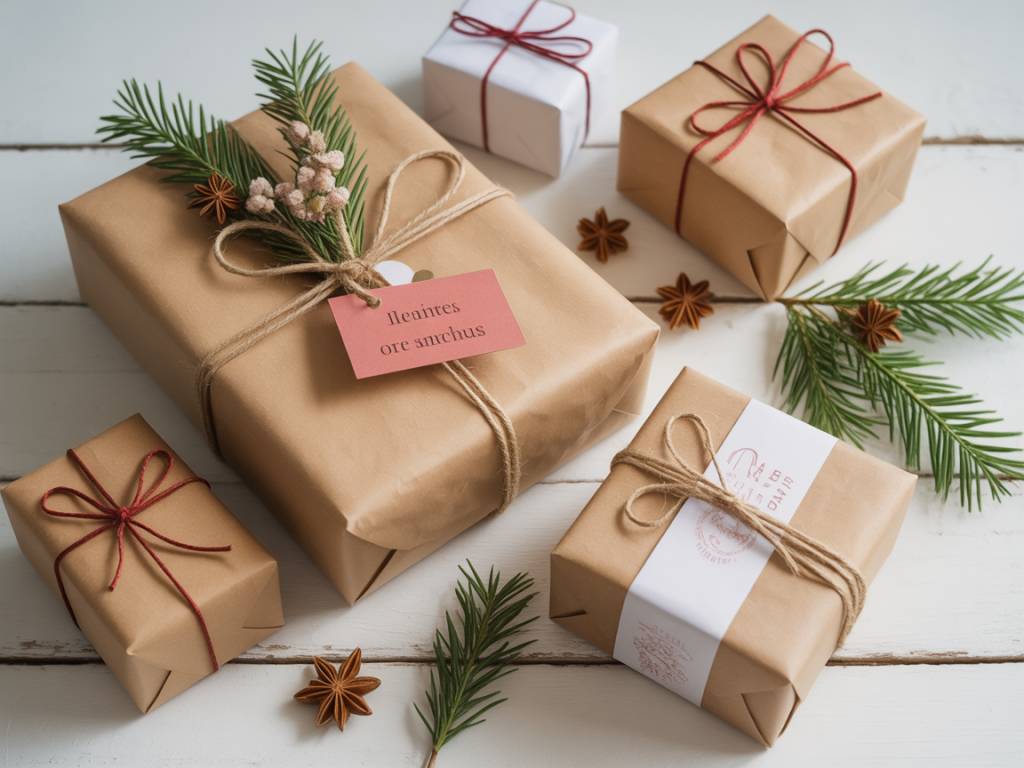
There is a small, secret joy in wrapping a gift. For a brief moment, the object disappears, remplacé par une promesse. The paper becomes a kind of architecture: it frames the surprise, sets the tone, and sometimes, it’s cherished as much as what lies inside.
What if our wrapping didn’t end up crumpled in a bin, but stayed in the home as a decorative object? Today, let’s explore wrapping ideas that turn simple gifts into beautiful keepsakes – pieces that can live on shelves, desks, and bedside tables long after the ribbon has been untied.
Fabric wrapping that becomes part of the home
Imagine a present wrapped not in paper, but in a soft linen tea towel, a patterned scarf, or a square of cotton. The gift is hidden, yes, but the wrapping is already a useful, beautiful object in its own right.
This technique, inspired by the Japanese art of Furoshiki, is perfect if you love textiles and gentle, sustainable gestures at home.
Some ideas to try:
- Tea towel bundles: Wrap candles, books or kitchen accessories in a pretty tea towel and secure with a simple knot or a ribbon. Once unwrapped, the towel naturally finds a second life on a hook in the kitchen, or folded in a basket.
- Scarf-wrapped treasures: A lightweight scarf or bandana makes elegant wrapping for smaller items: a perfume, a notebook, a piece of jewellery in its box. Choose patterns that echo your recipient’s interior style: stripes for a minimalist home, florals for a romantic one.
- Reusable cloth squares: Cut squares of cotton, linen or muslin and hem the edges. Over time, you’ll build a small “wardrobe” of wrapping fabrics that can circulate between friends and family.
To make the wrapped gift look decorative, take a moment to shape the fabric: smooth the corners, create soft folds, and tie a knot that looks intentional rather than hurried. Place the finished parcel on a console table or under the tree and it already feels like part of the room, not just a transient object.
Brown paper, elevated into sculptural simplicity
Plain kraft paper is to wrapping what raw wood is to furniture: humble, timeless, and full of potential. With a little care, it can become a sculptural accent that feels both minimal and warm.
Try playing with structure and texture instead of colour:
- Architectural folds: Instead of wrapping tightly, leave one side looser and create a series of crisp pleats. Secure with discreet tape, then wrap a thin ribbon or twine around the middle. The folds cast gentle shadows and give the parcel a subtle, architectural presence.
- Paper “collars” and “cuffs”: Wrap the gift simply, then add an extra strip of kraft paper around its centre or at one edge, as if dressing it with a belt or cuff. Slightly offset the secondary strip and fix it with a single, visible brass staple or a wax seal for a graphic, modern touch.
- Layered neutrals: Combine pale kraft, recycled white paper, and a strip of tracing paper. The transparency of the tracing paper lets the layer beneath show through, like voile curtains catching the light.
A cluster of gifts wrapped in brown paper and arranged on a bench or by the fireplace instantly reads as decor: calm, tonal, and quietly sophisticated.
Botanical details that bring the outside in
Sometimes, it’s a single stem that transforms a parcel into a small still life. Fresh or dried, botanicals bring movement, colour, and the softness of nature to your wrapping.
Consider:
- Evergreen sprigs and herbs: A sprig of rosemary or thyme slipped under twine, a small branch of eucalyptus against white paper, or a little pine cutting on kraft paper evokes scent before the gift is even opened. Once unwrapped, the sprig can be placed in a tiny bud vase or simply left to dry on a shelf.
- Dried flowers and grasses: Dried lagurus (bunny tails), wheat, or statice add a poetic, slightly vintage feel. Fasten them gently with a ribbon rather than tape, so they can be reused in a vase or pinned to a moodboard.
- Pressed leaves as modern “labels”: Press flat leaves between books a few days in advance, then write the recipient’s name directly on the leaf with a fine-tip pen. It becomes both label and decorative accent.
When you stack these botanically adorned gifts on a sideboard, they echo the plants and flowers already in your home, blurring the line between wrapped parcel and intentional vignette.
Wrapping as wall art: paper meant to be displayed
Some papers are too beautiful to be discarded. Why not choose wrapping that is designed to be reused as art once the gift is opened?
You can gently steer your recipient in this direction by how you wrap and what you include:
- Wrap with “future frames” in mind: Look for wrapping papers with graphic patterns, botanical illustrations, or abstract motifs. Tell your recipient, “This paper looks lovely framed,” and encourage them to smooth it out and pop it behind glass.
- Include a simple hanging clip: Slip a wooden clipboard clip or a metal bulldog clip under the ribbon. Once unwrapped, they have both the decorative paper and a way to hang it – on a peg rail, above a desk, or in a hallway.
- Maps and sheet music: Vintage maps, old music scores, or pages from large-format art books make memorable wrapping and transition effortlessly into wall decor. A city map can be hung in an entryway; sheet music can bring charm to a music room or reading nook.
Visualize a bedroom wall with a small gallery of framed papers from gifts past – a quiet archive of celebrations that still speaks softly in the everyday.
Personalised papers that tell a story
Sometimes, the wrapping itself can narrate a shared memory or an inside joke, making the gift an emotional object long before it is opened.
To bring that intimacy into your wrapping:
- Hand-drawn patterns: Use rolls of plain white or kraft paper as a blank canvas. With a simple black pen or brush marker, you can sketch small motifs: houses, leaves, constellations, or even a map of your neighbourhood. The imperfect lines will feel human and warm.
- Photo strips and postcards: Instead of a standard tag, attach a small printed photo or postcard that relates to a shared moment. Your friend might pin it on a memo board later, carrying the story forward.
- Stamped messages: Rubber stamps with letters or simple shapes allow you to repeat a word (“joy”, “home”, “rest”) across the paper like a gentle mantra. The wrapped gift becomes a physical wish for the person’s space.
When these parcels are placed together – perhaps on a side table in the living room – they read like small chapters of a story, each one addressed to someone specific, each one already part of their personal landscape.
Natural and recycled elements that feel quietly luxurious
There is a particular kind of luxury in materials that feel honest and tactile. Recycled paper, twine, and found objects may sound simple, but they can create wrapping that feels far more refined than glitter or plastic.
For a sustainable yet elegant look:
- Reused paper with new patterns: Plain sides of shopping bags, old packing paper, or large envelopes can be ironed gently on low heat (under a tea towel) to smooth them out. Add a single stripe of washi tape or a painted band of colour, and suddenly they feel intentional.
- String, jute, and raffia: Replace shiny synthetic ribbons with cotton string, natural jute or raffia. Layer several strands and let the ends hang a little longer than usual so they drape off the edge of the gift, catching the light on a tabletop.
- Found objects as charms: A small shell from a favourite beach, a key from a flea market, a tiny pinecone, a wooden bead… tied onto the ribbon, these little objects can later live in a dish on a coffee table or hang from a drawer pull.
Clustered together, these gifts look like they belong in a serene, natural interior – the kind where every object has a story and nothing shouts for attention.
Wrapping that doubles as storage
One lovely way to ensure your wrapping lives on is to choose containers that can be reused in the home. Instead of single-use paper, think in terms of boxes and baskets that become part of the decor.
- Decorative storage boxes: Place the gift inside a sturdy, beautifully patterned box. Wrap only the box lid with a strip of paper or fabric, leaving the sides visible. Later, the box can hold letters, art supplies, or seasonal decorations on a shelf.
- Woven baskets and trays: Slip smaller items in a cloth bag and nestle them into a basket or shallow tray. Add tissue paper or a folded tea towel on top, then tie a ribbon around the whole basket. Long after the celebration, the basket might find its place by the sofa, filled with magazines or throws.
- Glass jars for tiny gifts: For smaller items—jewellery, sweets, bath salts—use a glass jar with a lid. Decorate it with a band of paper or fabric and a tag. Once emptied, the jar can live on as storage in the kitchen or bathroom.
On a shelf or sideboard, these “wrapped” gifts look like they are already part of the home’s organising rhythm, slipping quietly into daily life afterwards.
Play with layers, heights and groupings
If you’re wrapping several gifts, you have the chance to compose a tiny, temporary landscape in your interior. Think about how the parcels will sit together: their sizes, colours, and textures.
To make your gift corner feel like a styled vignette:
- Vary the sizes: Stack a large, simple box at the bottom, a medium gift with more detailed wrapping in the middle, and a small, delicate package on top. The eye naturally moves upwards, as with a carefully arranged pile of books.
- Stay within a palette: Choose two or three main tones—perhaps soft whites, sand, and forest green—and repeat them across your wrapping. The result feels curated rather than chaotic.
- Add one “hero” element: Maybe one gift has an exuberant bow in velvet ribbon, or a large botanical stem; the others can remain more discreet. This creates a focal point without visual noise.
Placed on a low sideboard, a bench at the end of the bed, or even on the floor by a favourite armchair, the grouping becomes an ephemeral decorative installation in your home.
Creating small rituals around unwrapping
Finally, remember that the way the paper is opened is part of the beauty. Encourage your recipient to unwrap slowly, to keep the paper, to smooth it out and imagine where it might live next: on a wall, in a drawer, as a book cover, or folded in a box for future gifts.
You might gently say, with a smile: “The paper is for you too.” It’s a simple sentence, but it invites a different way of looking at the object in their hands—not as waste, but as a little piece of home waiting to be discovered.
Next time you sit at your table with scissors and tape, perhaps with a mug of tea nearby, imagine each gift not just as something to be given, but as a tiny decorative companion for someone’s space. In this way, wrapping becomes more than a final step; it becomes an act of interior design, folded softly around a gesture of care.