
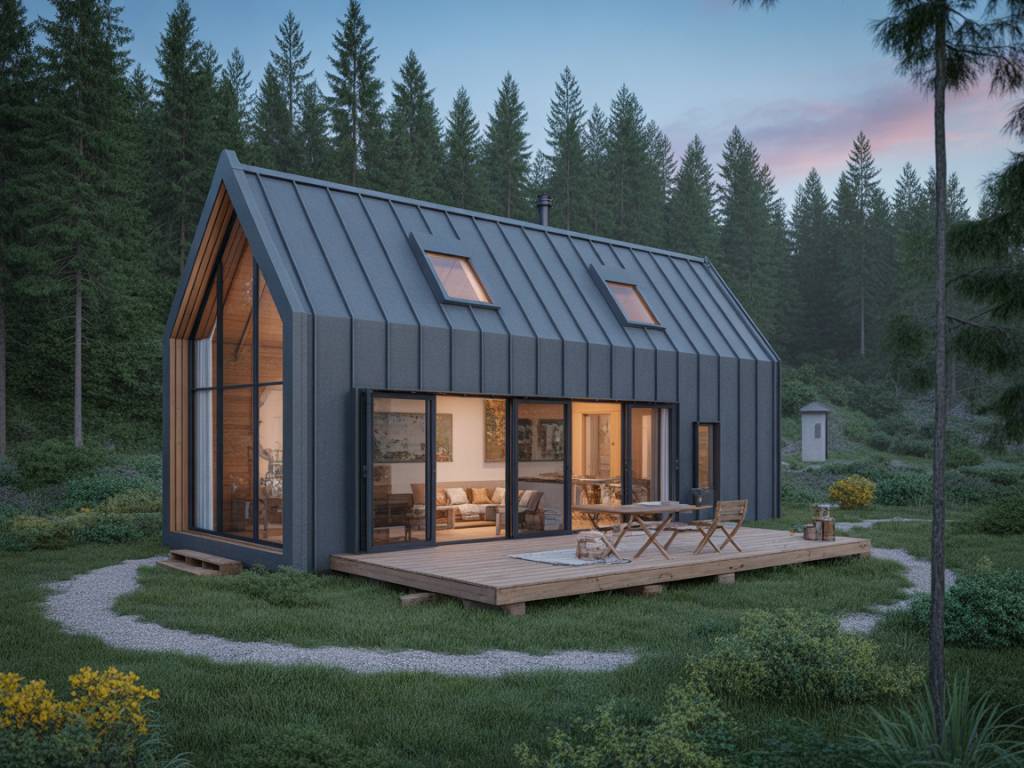
The first light falls across hand-picked timber beams. Outside, the wind moves through the trees. Your home is already awake — not because the grid woke it, but because it gathered yesterday’s sun and stored it quietly overnight. This is what thoughtful off-grid living looks like in practice: not a survivalist retreat, but a beautifully considered space where comfort, independence and natural materials coexist without compromise.
If you have been exploring off grid house ideas for sustainable design, energy independence and modern rustic living, you already know the appeal goes far beyond cutting electricity bills. It is about building something intentional — a home that works with its landscape, treads lightly, and feels rooted in something real.
Off grid house ideas for sustainable design: start with the land
Before a single solar panel is ordered or a wood stove is chosen, the most powerful sustainable design decision you can make is how your home sits on its plot. Passive design — working with sun, wind and topography — can dramatically reduce the energy your home needs in the first place.
Orientation and solar gain
- South-facing glazing (in the northern hemisphere) captures low winter sun to warm thermal mass naturally, reducing heating demand by up to 30% in well-designed homes.
- Deep roof overhangs (typically 600–900mm) shade those same windows in summer, preventing overheating without air conditioning.
- Compact floor plans with fewer external wall surfaces lose less heat — a square or rectangular layout performs significantly better than a sprawling L-shape.
Thermal mass and insulation
- Rammed earth, adobe or stone walls absorb heat during the day and release it slowly at night, acting as a natural buffer against temperature swings.
- Polished concrete floors over underfloor heating systems work on the same principle — warm slowly, stay warm longer.
- High-performance insulation (think 300mm+ in the roof, triple glazing, minimal thermal bridging) means your energy systems stay modest and your comfort stays consistent.
A well-oriented, well-insulated shell is the single most cost-effective investment in off-grid sustainable design. Everything else — the solar array, the battery bank, the stove — simply becomes smaller and more affordable as a result.
Energy independence: solar power, storage and smart design
Energy independence is the cornerstone of most off-grid house ideas, and modern technology has made it more accessible — and more elegant — than ever before.
Solar panels: the backbone of off-grid power
- A typical off-grid home in the UK or northern Europe needs between 4kWp and 10kWp of solar capacity depending on size, efficiency and lifestyle.
- Ground-mounted arrays can be tilted at the optimal angle (around 35–40° in the UK) and kept cooler than roof-integrated systems, improving output by 5–10%.
- Even if you start small, install conduit and cable runs for future expansion — it is far cheaper than retrofitting later.
- East-west split arrays spread generation more evenly across the day, reducing reliance on battery storage during peak morning and evening consumption.
Battery storage: the quiet heart of the system
- Modern lithium iron phosphate (LiFePO4) batteries offer 3,000–6,000 charge cycles with minimal degradation — typically 10–15 years of reliable service.
- Size your battery bank to cover 2–3 days of average consumption without recharge, accounting for cloudy winter periods.
- Prioritise essential loads (lighting, fridge, water pump, communications) at 12–24V DC where possible to avoid inverter losses and simplify the system.
- A well-designed off-grid energy system absolutely supports warm lighting, a quality coffee machine and a reliable hot shower — it just requires honest accounting of what you use.
Wind and micro-hydro for the right sites
Solar works beautifully in most locations, but if your plot is in a reliably exposed or elevated position, a small wind turbine (1–6kW) can generate power through the night and during overcast seasons — exactly when solar output dips. A fast-moving stream? A micro-hydro system running at even modest flow rates can deliver a near-continuous baseload that no solar array can match. These are site-specific options, but when conditions are right, they transform energy independence from aspirational to effortless.
Modern rustic living: materials, warmth and the wood stove
The aesthetic of off-grid modern rustic living is not simply a style choice — it is deeply functional. Natural materials regulate humidity, age gracefully and connect a home to its landscape in a way no synthetic finish can replicate.
Materials that earn their place
- Exposed structural timber — oak, Douglas fir, larch — brings warmth and character while sequestering carbon for the life of the building.
- Lime render and lime plaster are breathable, naturally anti-mould and repair beautifully over time.
- Reclaimed stone for flooring or feature walls adds thermal mass while honouring the history of the material.
- Cork, hemp and sheep’s wool insulation offer excellent performance with far lower embodied energy than conventional alternatives.
The wood stove: elemental and efficient
Few things define the mood of an off-grid home quite like a wood-burning stove. The soft tick of cooling cast iron, the amber glow on stone flagstones — it is comfort made visible. Modern stoves have evolved significantly:
- Look for DEFRA-approved, Ecodesign-ready models with efficiency ratings above 80% and clean-burn technology that reduces particulate emissions by up to 90% compared to older designs.
- A stove with a back boiler or water jacket can heat both your living space and your domestic hot water simultaneously — a significant gain in a small off-grid home.
- In a well-insulated 80–120m² home, a 5–8kW output stove is typically sufficient — oversizing leads to overheating and inefficient burning.
Cooking and the off-grid kitchen
- A range cooker with integrated oven — wood, biomass or gas — provides both a cooking surface and supplemental space heating, making it one of the most efficient appliances in a rustic off-grid kitchen.
- In summer, a separate outdoor kitchen or a propane hob keeps excess heat out of the living space entirely.
- Bottled LPG remains a practical backup for cooking in systems where solar generation dips in winter.
Water systems: rain, flow and the invisible infrastructure
Water is where off-grid sustainable design becomes quietly poetic. Every drop has a journey — from the cloud, across your roof, into storage, through filtration and out of the tap. Designing that journey well is both practical and deeply satisfying.
Rainwater harvesting
- First-flush diverters discard the initial dirty runoff from the roof before water enters the storage tank.
- A 200–10,000 litre buried tank (depending on roof area and average rainfall) provides a meaningful buffer through dry periods.
- Filtration train: sediment pre-filter → activated carbon filter → UV sterilisation → drinking water. This sequence can bring harvested rainwater to potable standard cost-effectively.
- Pairing rainwater collection with low-flow fixtures (aerated taps, dual-flush toilets, water-efficient showers) can reduce household consumption to 50–80 litres per person per day, compared to a UK average of around 150 litres.
Greywater and waste
- Reed bed systems or constructed wetlands treat greywater naturally, then release it safely to land or use it for garden irrigation — a living, functional landscape feature.
- Composting toilets eliminate the need for a sewage connection entirely while producing a pathogen-free soil amendment after 12–24 months.
- Where a borehole is viable, a solar-powered pump feeding a pressure vessel creates a fully independent water supply with no ongoing utility costs.
Bringing the off grid house ideas together: design for your life
The most important truth about off-grid design is that there is no single template. A fully off-grid homestead in rural Scotland looks very different from a grid-tied-with-autonomy home in the English countryside, which looks different again from a compact off-grid cabin in the Welsh hills. What they share is intention: every system, every material, every window position has been considered in relation to the landscape, the climate and the people who will live there.
Start with passive design — orientation, insulation, thermal mass. Then layer in your energy systems. Choose materials that are honest about what they are. Let the stove anchor the living space. Design your water journey with care. And let the home grow into its landscape over time, rather than sitting apart from it.
That is the real promise behind the best off grid house ideas for sustainable design, energy independence and modern rustic living — not austerity, but abundance on your own terms.