
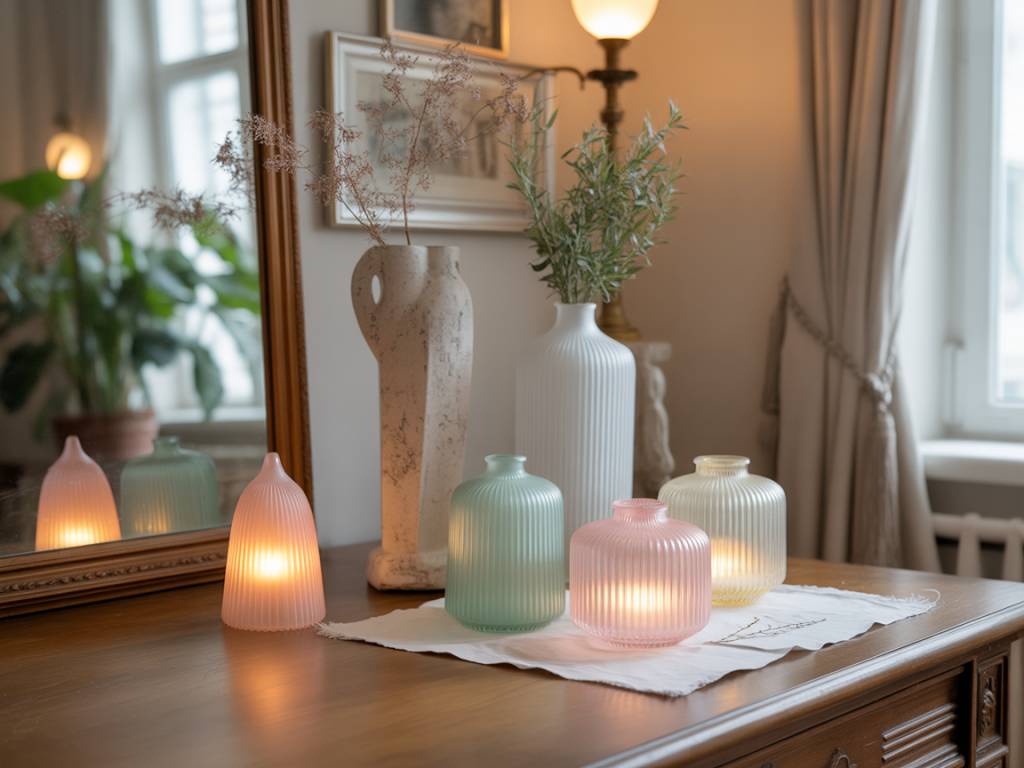
There is a particular kind of light that doesn’t come from a window or a lamp — it comes from the object itself. Opaline glass has exactly that quality: milky, hushed, and faintly translucent, it seems to hold daylight inside it and release it slowly into a room. If you’ve ever paused at a flea market over a pale vase that looked almost edible — like a scoop of sorbet or a sugared almond — you already understand the pull. What’s less obvious is just how versatile, contemporary, and genuinely practical opaline glass can be in today’s interiors. Here’s everything you need to know to style it with confidence.
What is opaline glass and why does it glow like that?
Opaline glass is a semi-opaque glass made by adding bone ash, tin oxide, or arsenic to the molten mixture during production. These additives scatter light as it passes through the glass, creating the signature milky, luminous appearance rather than a clear reflection. The result is a material that doesn’t just reflect light — it diffuses it, giving off a soft, almost candlelit warmth.
Originally developed in Venice, opaline glass became widely popular in 19th-century France, where artisans produced decorative objects in white, pale blue, sage green, and blush pink. Today, both vintage pieces and contemporary reproductions are widely available, making it accessible at almost any budget.
Common forms include:
- Vases and decorative bowls
- Perfume bottles and vanity accessories
- Pendant lights and ceiling shades
- Table lamps and wall sconces
- Storage jars, trinket dishes, and lidded boxes
Unlike crystal or clear glass, opaline softens edges, blurs reflections, and lowers the visual temperature of a space — which is precisely why it suits so many different interior styles.
Opaline glass in interior design: why it works in modern homes
Today’s homes are often caught between two competing desires: a need for calm and a love of character. Opaline glass sits naturally at that crossroads. It brings visual interest without noise, history without heaviness, and a warmth that harsh, glossy finishes simply cannot replicate.
Here’s why interior stylists keep reaching for it:
- It flatters natural light. Placed on a windowsill or near a lamp, opaline catches and scatters light in a way that feels almost spa-like — particularly beautiful in north-facing rooms that struggle with flatness.
- It works across styles. In a minimal interior, it adds organic softness. In a bohemian or eclectic space, it acts as a visual anchor amid busier elements.
- It carries history without feeling dated. Vintage opaline pieces bring a sense of story and provenance, yet their clean, pastel palette reads as entirely fresh and current.
- It layers beautifully with texture. Linen, rattan, raw wood, and unglazed ceramics all make opaline glow more vividly by providing contrast.
If you’re drawn to interiors that feel luminous but not cold, layered but not cluttered, opaline is one of the most reliable tools available.
How to choose the right opaline pieces for your space
Before committing to a piece — or a whole collection — it’s worth thinking about scale, function, and colour temperature.
Scale: statement versus accent
A large opaline pendant light will define an entire room; a small trinket dish will simply whisper its presence on a shelf. Neither is wrong, but they demand different levels of commitment. If you’re new to opaline, start with a vase or a table lamp: vases are easy to reposition as you refine your styling, while lamps showcase the inner glow of opaline glass most dramatically.
Colour: cool or warm?
Opaline glass comes in a wider tonal range than most people expect. White and pale blue opaline suit cooler, more pared-back palettes. Peach, blush pink, and honey-toned opaline integrate more warmly into earthy or maximalist schemes. When in doubt, white is the most versatile starting point — it reads as neutral while still adding depth.
Function: beauty plus usefulness
Opaline is far more practical than it looks. Storage jars in opaline glass make beautiful organisers on kitchen shelves or bathroom counters. An opaline bowl by a front door catches keys and post. A lidded opaline box on a dressing table holds jewellery. Choosing functional pieces means your collection earns its place every single day.
Styling opaline glass room by room
Living room: quiet focal points
The living room is where opaline glass can gently steal the show. The key is contrast: opaline always glows more vividly when placed near something darker or more textural.
- Coffee table: A single opaline bowl on a stack of art books, flanked by a small stone or a sprig of dried eucalyptus, creates a composed vignette without visual noise.
- Sideboard: Group three pieces in varying heights — a tall vase, a medium lamp, a small dish — within the same colour family to avoid clutter. The rule of odd numbers applies here.
- Reading corner: An opaline table lamp fitted with a warm-white bulb (2700–3000K) transforms a corner into a proper cocoon. The glass intensifies the golden quality of the light.
In a minimal living room, one opaline element placed slightly off-centre keeps the space from feeling rigid. In an eclectic interior, opaline pieces act as visual « breathers » between more ornate objects.
Bedroom: a hushed, luminous atmosphere
Bedrooms are where opaline glass truly comes into its own. Its capacity to diffuse light rather than direct it makes it ideal for spaces where softness is the priority.
- Bedside tables: A pair of matching opaline lamps creates instant symmetry and a genuinely flattering light for reading. Even a single small vase adds a quiet note of luxury.
- Dressing table: Combine an opaline perfume bottle or powder jar with a linen-covered jewellery box and a small framed photograph. The mix of glass, fabric, and personal memory feels intimate and timeless.
- Window ledge: A row of small opaline bud vases — even left empty — catches morning light like a line of tiny moons. Simple, and quietly spectacular.
Kitchen and dining room: everyday rituals, elevated
Opaline glass is underused in kitchens and dining rooms, which is a shame — it can live beautifully among everyday objects without feeling precious or out of place.
- Open shelving: Arrange opaline storage jars among your everyday crockery. Use them for tea, sugar, or spices you reach for often. The practical use earns their display.
- Dining table: A low opaline vase with seasonal branches, or a pair of small opaline bowls holding floating candles, sets a gentle, intimate tone for dinners without overwhelming the table.
- Above the table: An opaline pendant — or a cluster of smaller shades at varying heights — gives the kind of warm, diffused light that flatters both food and faces. It’s the closest you can get to that café-in-Paris feeling at home.
Bathroom: cool serenity
The bathroom is perhaps the most natural home for opaline glass. Its cool, mineral quality echoes marble, stone, and white ceramic effortlessly.
- Replace plastic dispensers with opaline glass bottles for hand soap and lotion.
- Use a small opaline dish for soaps or candles on the edge of the bath.
- A single opaline wall sconce beside a mirror transforms the quality of light entirely — warm, diffused, and deeply flattering.
Colour palettes that work beautifully with opaline glass
Opaline’s milky, pastel nature means it needs the right backdrop to truly shine rather than disappear.
- Soft neutrals: Warm greys, greige, and creamy whites paired with natural wood let opaline read as a refined accent. The result feels calm and light-filled all day.
- Earthy tones: Terracotta, clay, and olive green make opaline’s cool glow feel more pronounced by contrast — particularly effective in living rooms and kitchens.
- Moody darks: Against deep charcoal, inky blue, or forest green, opaline stands out like moonlight against a night sky. Ideal for bedrooms or intimate dining rooms.
- Pastel-on-pastel: For a dreamy, nostalgic look, pair pale pink or soft blue opaline with walls in similar tones — but keep furniture lines clean and simple to avoid tipping into saccharine.
When uncertain, place your opaline piece near something darker and textural — a wooden tray, a woven mat, a linen runner. This simple contrast is almost always enough to make the glass come alive.
Caring for vintage opaline glass
Opaline glass is more robust than it looks, but a few precautions will keep it beautiful for years.
- Wash by hand in lukewarm water with a mild detergent — dishwashers can dull the surface over time.
- Dry immediately with a soft cloth to avoid water marks, which are particularly visible on the milky surface.
- Keep out of prolonged direct sunlight, which can cause some tinted opaline pieces to fade gradually.
- When buying vintage, check the rim and base for fine chips — these are common and rarely structural, but good to know before styling a piece in a high-traffic spot.
Opaline glass in interior design rewards patience and an instinct for quiet beauty. It doesn’t shout, it doesn’t demand attention — it simply glows. And in a world of surfaces competing for notice, that kind of restraint feels more considered, and more lasting, than ever.